

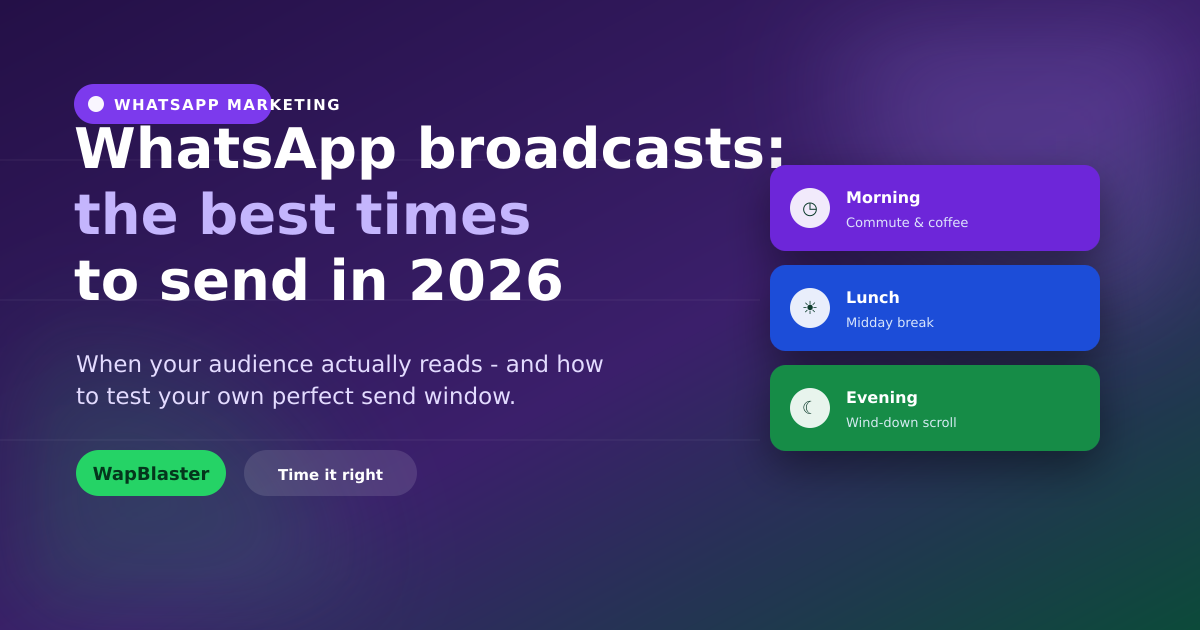
You can write the perfect broadcast and still get ignored if it lands at the wrong moment. Timing shapes open, read and reply rates more than most businesses realise. This guide covers the send windows that generally work best and, more importantly, how to find the perfect time for your own audience.
Why timing matters so much
WhatsApp messages are read within minutes, so a message that arrives when your audience is busy or asleep gets buried under later chats.
- Arrive at a good moment and you catch people with attention to spare.
- Arrive at a bad one and you compete with a pile of newer messages.
- Relevance still matters most, but timing amplifies it.
General best windows
As a starting point, these windows tend to perform well for consumer audiences.
- Mid-morning: after the commute, when people check phones over coffee.
- Lunch break: a midday lull with idle scrolling.
- Early evening: the wind-down window after work.
Avoid very early mornings, late nights and the middle of the workday.
It depends on your audience
B2B audiences engage during work hours; consumers often prefer evenings and weekends. A food brand and a software company have completely different peak times. Your data beats any generic rule.
How to find your perfect time
- Split a segment and send at different times, then compare read and reply rates.
- Check your analytics for when past messages performed best.
- Respect time zones if your audience spans regions.
- Re-test occasionally, habits shift.
Timing is not everything
Even perfect timing cannot save an irrelevant message. Pair good timing with tight targeting and relevance, and keep frequency sensible so you stay welcome. Then use a scheduler to hit your window automatically.
Frequently asked questions
What is the best time to send a WhatsApp broadcast?
For consumer audiences, mid-morning, the lunch break and early evening tend to perform best, while very early mornings, late nights and the mid-workday do worst. But your own audience's data should guide the final decision.
Does send time really affect open rates on WhatsApp?
Yes. Because WhatsApp messages are read within minutes, one sent at a busy or sleeping moment gets buried under later chats. Good timing amplifies a relevant message's open and reply rates.
How do I find the best send time for my audience?
Split a segment and send at different times, then compare read and reply rates, and review analytics for when past messages performed best. Account for time zones and re-test occasionally as habits change.
Is timing more important than the message itself?
No. Relevance and targeting matter most; timing amplifies a good, relevant message but cannot rescue an irrelevant one. Combine strong targeting, sensible frequency and good timing for the best results.
Send at the perfect moment. Schedule with WapBlaster broadcasts or start free.