
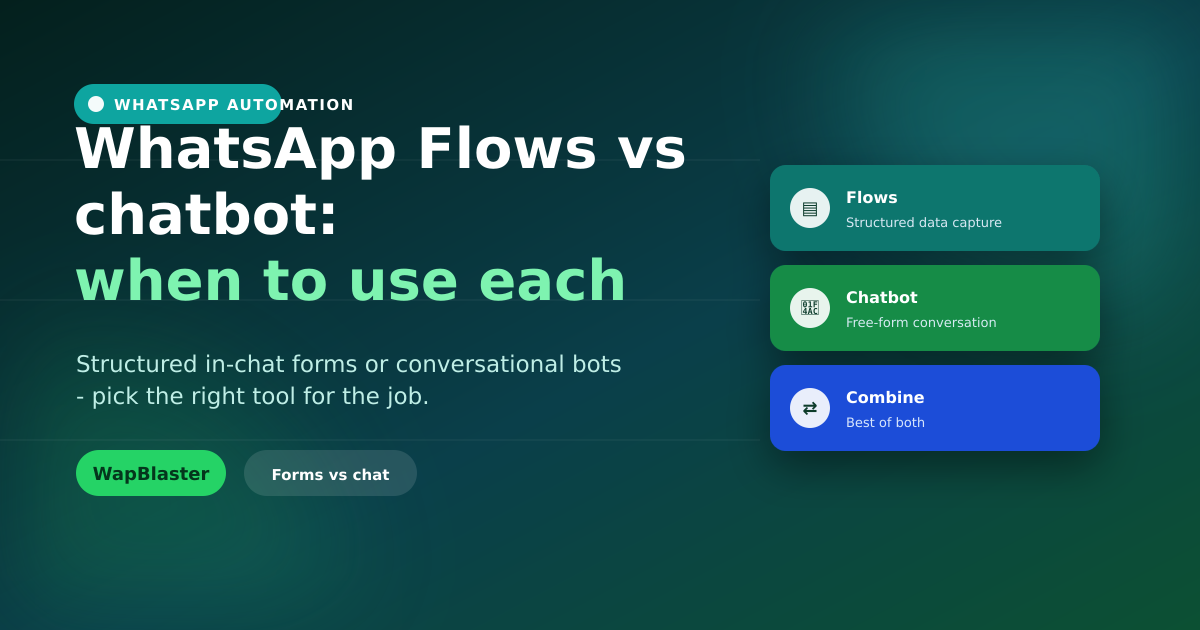
WhatsApp Flows and chatbots are both automation tools, but they are built for different jobs. A chatbot holds a free-form conversation; a Flow is a structured, form-like experience inside chat. Choosing the wrong one leads to clunky journeys. This guide explains when to use each and how they work best together.
What a chatbot does best
A chatbot shines at open-ended, branching conversation: answering questions, routing enquiries, and guiding people with tappable menus.
- Answering FAQs and qualifying leads conversationally.
- Routing to the right team or information.
- Handling unpredictable, varied questions.
What WhatsApp Flows do best
WhatsApp Flows present a clean, structured form inside chat, ideal when you need specific, consistent data.
- Bookings, registrations and applications.
- Collecting structured details like address or preferences.
- Multi-field input that would be messy as back-and-forth chat.
A simple rule of thumb
If you are having a conversation, use a chatbot. If you are collecting structured data, use a Flow. Most journeys benefit from both: a chatbot greets and qualifies, then hands off to a Flow to capture details cleanly.
Combine them for the best journey
The strongest automations blend the two. A chatbot engages the customer and understands intent, then triggers a Flow to collect what you need, and returns to the bot (or a human in your team inbox) to finish. This feels natural and captures clean data.
Avoid common mistakes
- Do not force a long form into chatbot back-and-forth, use a Flow.
- Do not use a rigid Flow where people expect to ask questions.
- Always offer a route to a human for anything complex.
Frequently asked questions
What is the difference between WhatsApp Flows and a chatbot?
A chatbot holds an open-ended, branching conversation, good for FAQs, routing and qualification. A WhatsApp Flow is a structured, form-like experience inside chat, good for bookings, registrations and collecting specific data. They suit different jobs.
When should I use a WhatsApp Flow instead of a chatbot?
Use a Flow when you need specific, consistent, multi-field data such as a booking or application. A form-style Flow is cleaner than collecting many fields through conversational back-and-forth, which gets messy and error-prone.
Can I use Flows and a chatbot together?
Yes, and it is often best. Let a chatbot greet, qualify and understand intent, then trigger a Flow to capture structured details, and return to the bot or a human to finish. This feels natural and yields clean data.
Do Flows replace chatbots?
No. They complement each other. Flows handle structured data capture; chatbots handle conversation. Using each for what it does best produces the smoothest customer journey.
Build the right automation. Explore the chatbot builder and WhatsApp Flows, or start free.