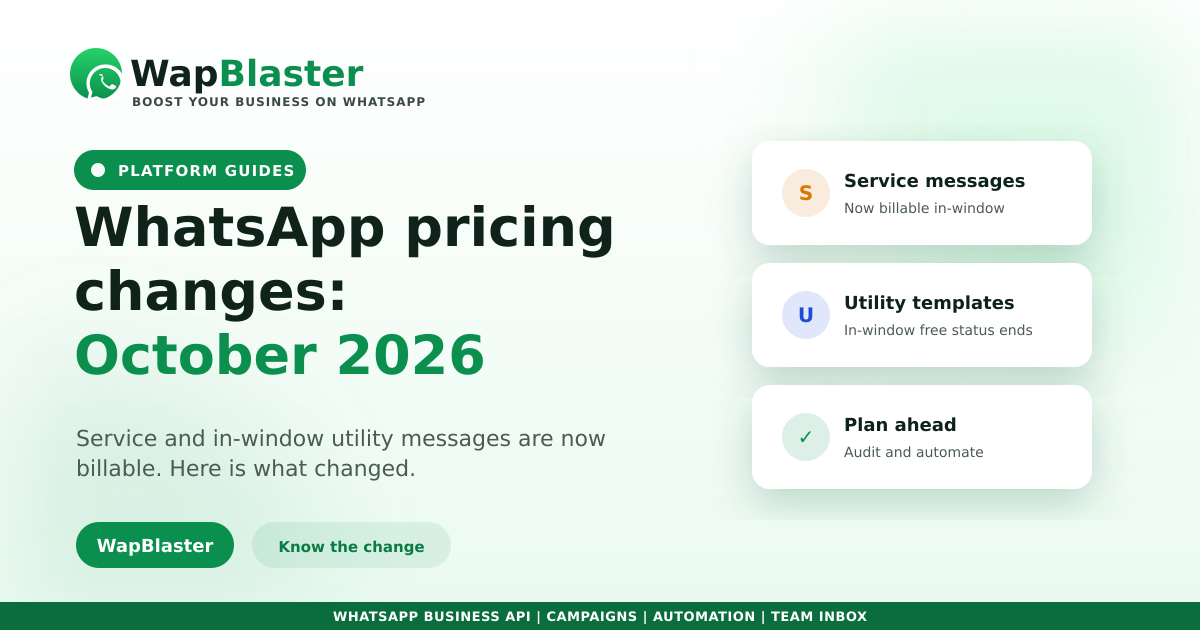
If you run WhatsApp campaigns or support, the October 2026 pricing change matters to your budget. From 1 October 2026, Meta began charging for two things that used to be free: service messages (free-form replies inside the 24-hour customer window) and utility templates sent inside that window. This guide breaks down what changed, why, and how to keep costs under control.
What actually changed
Two previously-free message types are now billable per message.
- Service messages: free-form replies to a customer inside the 24-hour window are now charged.
- Utility templates: these lost the in-window free status they had enjoyed, and are now billed per message.
- Authentication and marketing templates continue to be charged as before.
This sits on top of the earlier move to per-message billing, explained in our conversation pricing guide.
Why Meta made the change
The shift continues Meta's move toward a simpler, per-delivered-message model and reflects the real cost of high support volumes. For businesses, it means every message, including replies you used to send freely, now carries a cost worth managing.
What it means for your budget
If you run high-volume support or send lots of utility updates inside the customer window, your bill will rise unless you adapt. The impact depends on your message mix, so review how many service replies and in-window utility templates you send.
How to prepare
- Audit your message mix: how much is service, utility, marketing and authentication.
- Automate routine replies so you resolve faster with fewer paid messages.
- Consolidate updates rather than sending many separate utility messages.
- Encourage cheaper customer-initiated conversations where possible.
Our guide on reducing WhatsApp costs covers the tactics in detail.
Turn the change into an opportunity
Rising per-message costs reward relevance and efficiency, exactly what good marketing already does. Tighter targeting, smarter automation and clear analytics mean you spend on messages that drive outcomes, not noise.
Frequently asked questions
What changed in WhatsApp pricing on 1 October 2026?
Service messages (free-form replies inside the 24-hour window) and utility templates sent inside that window became billable per message. Previously both were free in-window. Authentication and marketing templates continue to be charged as before.
Are service messages still free on WhatsApp?
No. From 1 October 2026, free-form service replies inside the 24-hour customer window are charged per message. This is a significant change for businesses running high-volume support, so it is worth auditing your reply volume.
How do I reduce the impact of the pricing change?
Audit your message mix, automate routine replies to resolve faster with fewer paid messages, consolidate multiple utility updates into fewer messages, and encourage cheaper customer-initiated conversations where possible.
Does the change affect marketing templates?
Marketing and authentication templates continue to be charged as before; the October 2026 change specifically added charges for service messages and in-window utility templates. Your marketing budget logic is unchanged, but total support costs may rise.
Plan for the new pricing. Explore WapBlaster or start free.