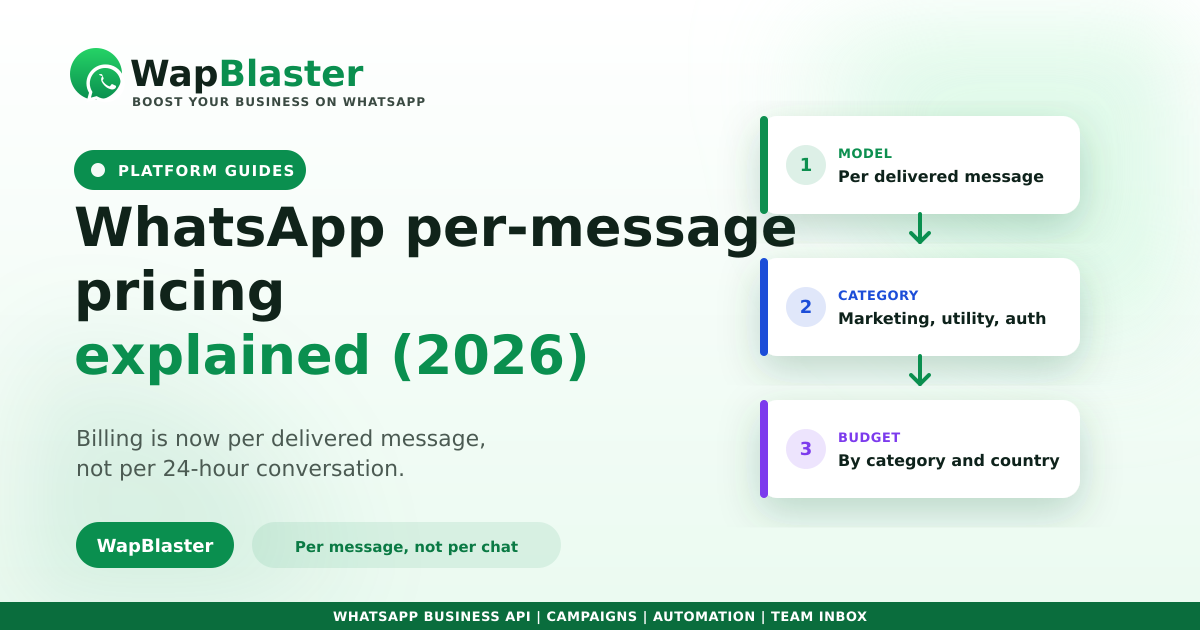
WhatsApp pricing has moved from the old per-conversation model to per delivered message. If you still think in terms of 24-hour conversation windows for billing, your cost estimates will be wrong. This guide explains how per-message pricing works in 2026, what drives your costs, and how to plan a budget you can trust.
From per-conversation to per-message
Under the old model, you paid for a 24-hour conversation regardless of how many messages it contained. Now, billing is per delivered template message, with charges attaching on delivery rather than on send. This changes how you estimate and optimise spend, as covered in our pricing models guide.
Categories still shape your costs
Message categories remain central to what you pay.
- Marketing: promotional messages, charged per message.
- Utility: transactional updates tied to an action.
- Authentication: verification codes.
- Service: replies inside the customer window.
Choosing the right category matters for both approval and cost, see our categories guide.
Charges attach on delivery
Because you are billed on delivery, undeliverable messages do not cost you, but every delivered marketing or authentication template does. Rates also vary by recipient country, so a campaign's cost depends on where your audience is.
How to budget accurately
- Estimate by category and destination country, not by conversation.
- Track cost per outcome, not just cost per message.
- Use analytics to see which campaigns justify their spend.
Optimise for the per-message world
Per-message billing rewards relevance: every wasted send is now a direct cost. Tight segmentation, strong opt-ins and automation that resolves faster all lower your effective cost, in line with our cost reduction guide.
Frequently asked questions
How does WhatsApp per-message pricing work in 2026?
You are billed per delivered template message rather than per 24-hour conversation, with charges attaching on delivery. Marketing and authentication templates are charged per message, and rates vary by recipient country and category.
What is the difference from the old conversation pricing?
The old model charged for a 24-hour conversation regardless of message count; the new model charges per delivered message. This makes each individual send a direct cost, so estimating by category and volume is now more accurate than by conversation.
Do undeliverable messages cost money?
Because charges attach on delivery, messages that are not delivered do not incur the delivery charge. Every delivered billable template, however, does, so list quality and targeting directly affect your effective cost.
How do I budget for per-message pricing?
Estimate by message category and recipient country rather than by conversation, track cost per outcome instead of just cost per message, and use analytics to identify which campaigns justify their spend and which to cut.
Budget with confidence. Explore WapBlaster or start free.