
Enterprise sales teams run on Salesforce, yet an increasing share of actual deal conversations happens on WhatsApp. Without an integration those conversations are invisible to the business, which is a governance problem as much as a productivity one. Here is how to connect the two properly.
What to sync
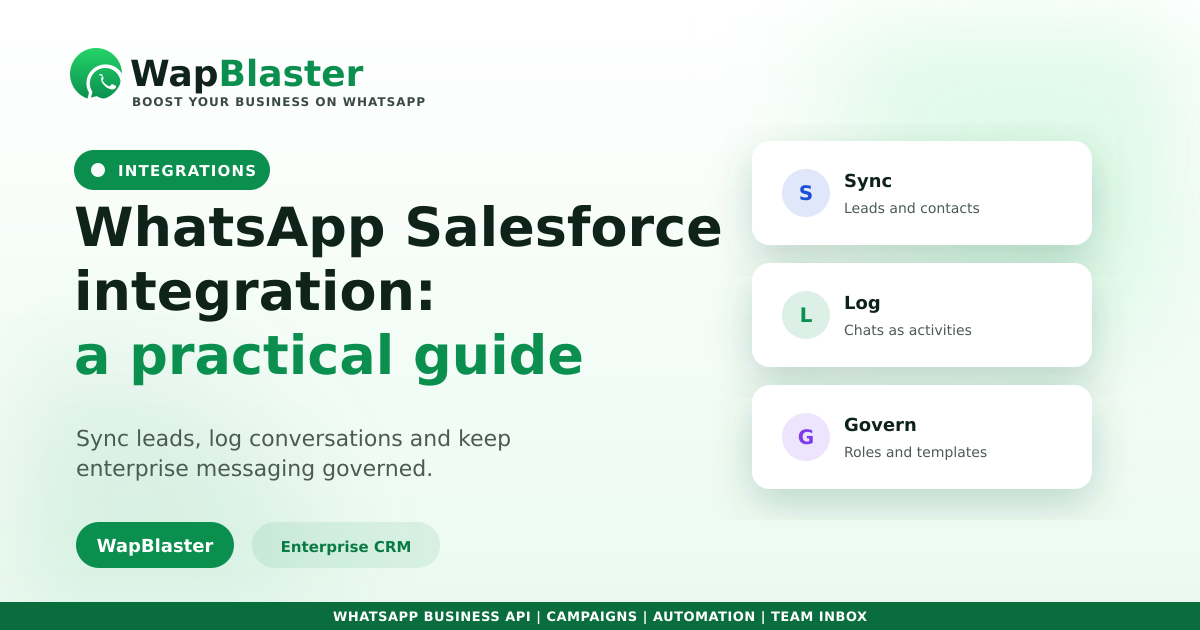
Decide deliberately what crosses the boundary, rather than syncing everything and creating noise.
- Leads and Contacts, matched on phone number.
- Conversation history logged as activities.
- Opportunity stage changes as message triggers.
- Message outcomes written back for reporting.
Setting it up
Connect your WhatsApp Business API number, authorise Salesforce, and map objects and fields carefully. Phone-number normalisation matters most here, since enterprise data is usually the messiest.
- Authorise Salesforce and choose the objects to sync.
- Normalise phone fields to a consistent country-code format.
- Assign conversation ownership to match record ownership.
- Route replies through a team inbox with role-based access.
Governance is the hard part
At enterprise scale, the risk is not technical but procedural. Approved templates keep messaging on-brand and compliant, role-based access limits who can message whom, and recorded consent keeps you inside policy. Monitor number quality across the org.
Prove the value
Write outcomes back to Salesforce so WhatsApp appears in pipeline reporting, not just in anecdotes. Track influenced opportunities and compare to cost using our ROI guide.
Frequently asked questions
Can Salesforce integrate with WhatsApp?
Yes. With an official WhatsApp Business API number connected to a platform that supports Salesforce, you can sync Leads and Contacts, log conversations as activities, and trigger messages from Opportunity stage changes or other record events.
What should I sync between Salesforce and WhatsApp?
Leads and Contacts matched on phone number, conversation history logged as activities, stage changes as message triggers, and message outcomes written back for reporting. Avoid syncing everything, which creates noise rather than clarity.
How do enterprises keep WhatsApp messaging compliant?
Use centrally approved templates so outbound messaging stays on-brand, apply role-based access so only the right people can message specific records, record consent against each contact, and monitor number quality across the organisation.
Why does phone-number formatting matter so much?
Matching between systems depends on it, and inconsistent numbers cause failed matches and undeliverable messages. Enterprise CRM data is often the messiest, so normalising to a consistent country-code format before syncing prevents most integration problems.
Bring WhatsApp into Salesforce. Explore WapBlaster API or start free.