
WhatsApp is rolling out usernames, letting customers contact a business without revealing their phone number. When that happens, the phone number you have always relied on to identify a contact may simply not be there. In its place is a new identifier called the BSUID. If your systems key everything off the phone number, this matters. Here is what is changing and how to get ready.
What usernames and BSUID are
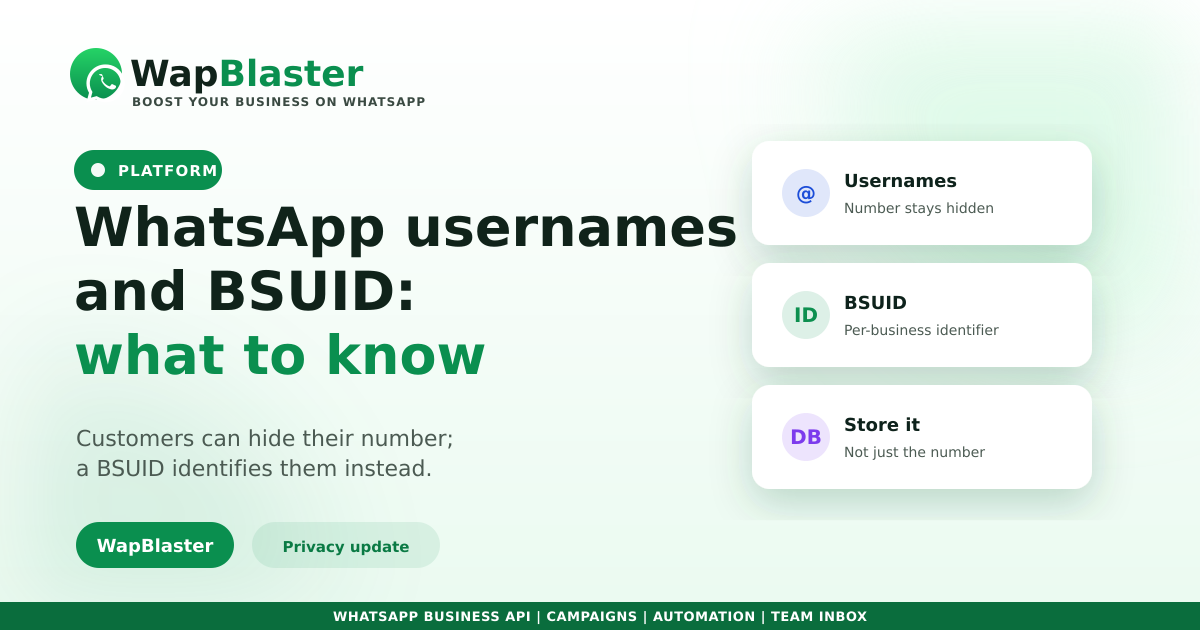
Usernames are an optional privacy feature for WhatsApp users. A customer who adopts one can message or call your business while keeping their number hidden.
- The customer's phone number may no longer appear in your webhook data.
- Meta provides a Business-Scoped User ID (BSUID) to identify that customer instead.
- The BSUID is unique to your business, so two companies cannot use it to match the same person.
- It is generated automatically, with nothing to request or migrate.
Why it matters for your business
Most CRMs, tools and automations treat the phone number as the primary key for a contact. If a first-time customer arrives with only a username and a BSUID, number-based matching breaks.
- New contacts may have no phone number on record.
- Deduplication and lookup logic that relies on the number can fail.
- Any outbound process that needs a number must handle its absence gracefully.
How to prepare
The fix is to treat the BSUID as a first-class identifier alongside the phone number.
- Store the BSUID against every contact, not just the number.
- Use a platform that captures and keys on BSUID so you do not have to re-engineer this yourself.
- Keep your CRM sync mapping the BSUID so history stays intact.
- Review consent records, since opt-in still applies regardless of how the customer is identified.
The upside
Usernames lower the barrier for privacy-conscious customers to start a conversation, which can mean more inbound chats. A business can also adopt a username so customers find you by name rather than a saved number. Handled well, this is a growth opportunity, not just a migration chore.
Frequently asked questions
What is a WhatsApp BSUID?
A Business-Scoped User ID is a unique identifier Meta generates for each customer-business pair. It lets you recognise and message a customer even when their phone number is hidden behind a username, and it is scoped so other businesses cannot use it to identify the same person.
Will I stop seeing customers' phone numbers?
Only for customers who adopt a username. For them, the phone number may no longer appear in your webhook data, and you identify them by their BSUID instead. Customers who have not adopted a username are unaffected.
Do I need to do anything to get a BSUID?
No. The BSUID is generated automatically for each customer-business pair. There is nothing to request or migrate, but you should make sure your systems store and key on it, not just the phone number.
Does opt-in still apply with usernames?
Yes. Consent rules are unchanged. You still need valid opt-in to send business-initiated messages, regardless of whether the customer is identified by a phone number or a BSUID.
Stay ready for the username era. Explore WapBlaster API or start free.