

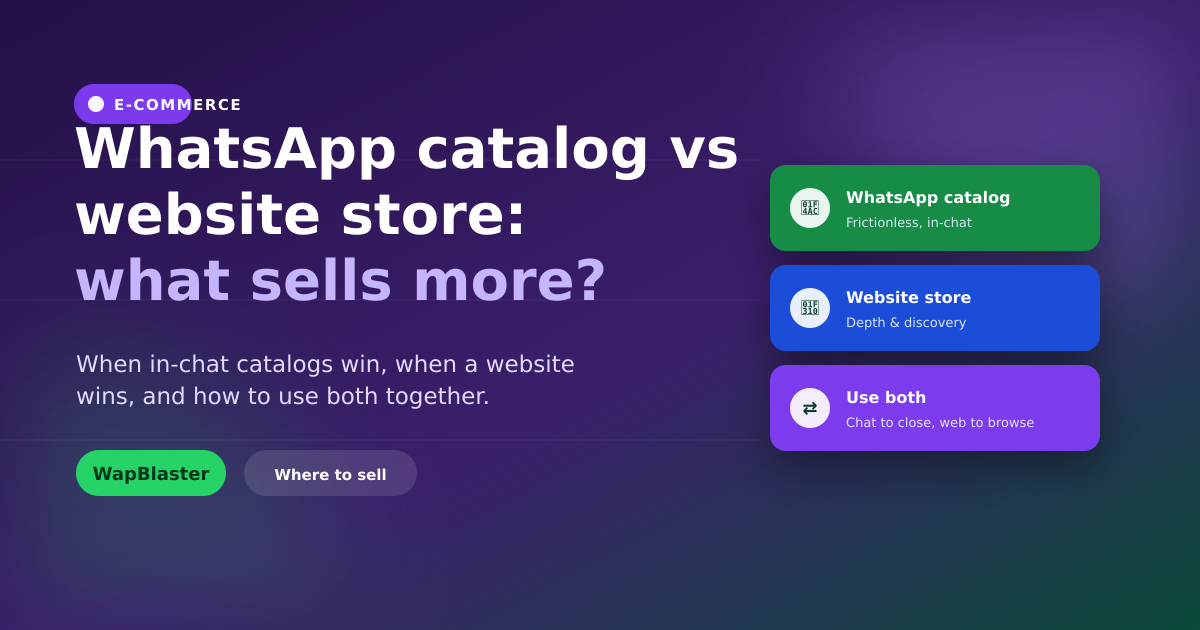
"Should I sell in a WhatsApp catalog or on my website?" is the wrong question. The right one is: where does each type of customer prefer to buy, and how do I use both together? A WhatsApp catalog and a website store solve different problems. This guide compares them honestly so you put your effort where it pays off.
The core trade-off: friction vs depth
A WhatsApp catalog wins on friction. There is no app to open, no account to create — the customer browses and buys inside a chat they already use. A website wins on depth: rich product pages, search, reviews, filters and unlimited range. One removes steps; the other adds discovery.
When a WhatsApp catalog wins
- Small or curated ranges where a full site is overkill.
- Conversational sales where customers ask before buying.
- Repeat purchases like groceries or refills, where speed matters most.
- Impulse and social traffic arriving straight into chat from ads.
Learn to set one up in our in-chat commerce guide.
When a website store wins
- Large catalogs that need search, categories and filters.
- Considered purchases where reviews and detailed specs drive the decision.
- SEO and discovery — your site earns search traffic a chat cannot.
- Complex checkout with multiple payment and shipping options.
The winning move: use both together
The best-performing brands do not choose. They let the website handle browsing and discovery, then use WhatsApp to close and retain.
- Website for depth and SEO; WhatsApp for conversation and speed.
- Recover abandoned carts on WhatsApp — see our cart recovery guide.
- Send order updates and reorders in chat via a store integration.
Compare on conversion, not vanity
Traffic means nothing if it does not convert. WhatsApp typically converts warm, conversational traffic better because it removes friction and lets you answer objections in real time. A website converts search and comparison shoppers better. Measure each channel by revenue per contact, not clicks.
What about cost?
A website carries build and maintenance costs but no per-message fee. WhatsApp has conversation costs but near-zero friction — see the pricing guide. For most brands the smart split is: invest in the site for discovery, and use WhatsApp to lift conversion and repeat rate on the traffic you already have.
Frequently asked questions
Is a WhatsApp catalog better than a website store?
Neither is universally better. A WhatsApp catalog removes friction and suits small ranges, conversational sales and repeat purchases. A website suits large catalogs, considered purchases and SEO. Most brands get the best results using both together.
Can I use a WhatsApp catalog and a website at the same time?
Yes, and you should. Let your website handle browsing, discovery and SEO, then use WhatsApp to answer questions, close sales, recover carts and drive reorders. The two channels complement each other rather than compete.
Which converts better, WhatsApp or a website?
WhatsApp usually converts warm, conversational and social traffic better because it removes friction and lets you handle objections live. Websites convert search and comparison shoppers better. Measure each by revenue per contact to see what works for you.
Does a WhatsApp catalog cost money to run?
There is no fee for the catalog itself, but conversations you initiate carry Meta's per-conversation charges. A website has build and hosting costs but no per-message fee. Using both lets you balance discovery cost against conversion cost.
Sell where customers buy. Set up in-chat commerce or start with WapBlaster.