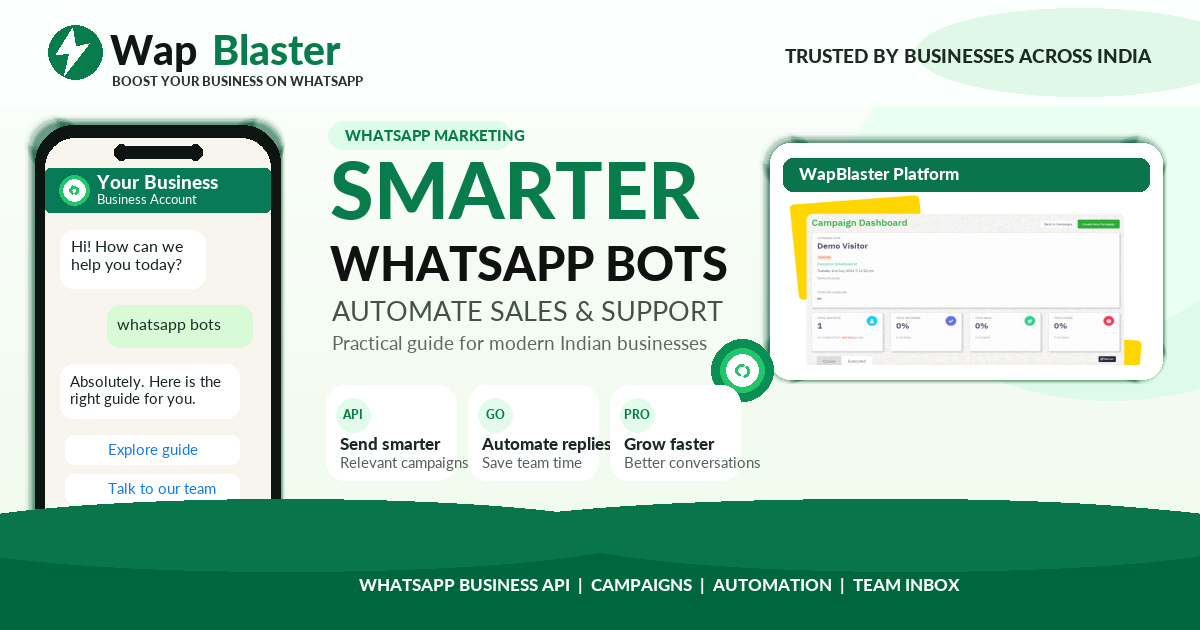
A WhatsApp chatbot lets you answer customers instantly, 24/7, qualify leads, take orders, and deflect repetitive support questions — all inside the app your customers already use every day. In this 2026 guide we explain what a WhatsApp chatbot is, the best use cases, how to design conversation flows that actually work, and how to build one without writing code.
What is a WhatsApp chatbot?
A WhatsApp chatbot is automated software that reads incoming messages and replies based on rules or AI. On the official WhatsApp Business API, a chatbot can greet customers, present menus of options, collect information, trigger actions (like creating an order or booking), and hand off to a human agent when needed.
There are two broad types:
- Rule-based (flow) bots follow a predefined decision tree: the customer picks options or types keywords, and the bot responds accordingly. They are predictable, easy to control, and perfect for structured tasks.
- AI-powered bots use natural-language models to understand free-form questions and generate answers. They are more flexible but need guardrails to stay accurate and on-brand.
Most successful deployments combine both: a structured flow for common journeys, with AI to handle open questions.
Why businesses use WhatsApp chatbots
- Instant responses. Customers expect replies in seconds; a bot never sleeps.
- Lower support costs. Bots deflect repetitive FAQs so agents focus on complex issues.
- Lead qualification. Bots collect key details before routing a hot lead to sales.
- Higher conversion. Answering a buying question at the exact moment of intent closes more sales.
- Scale. One bot can handle thousands of simultaneous conversations.
High-value use cases
Customer support automation
Handle order status, returns, business hours, pricing, and other FAQs automatically. Route anything the bot can't resolve to a live agent with full context.
Lead generation and qualification
Greet inbound enquiries, ask qualifying questions (budget, need, timeline), and pass qualified leads to your sales team or CRM.
Appointment booking
Let customers pick a service and a time slot inside the chat, then confirm and send reminders automatically.
Order taking and tracking
Present a catalogue, collect the order and delivery details, confirm, and provide tracking — entirely in WhatsApp.
How to design a chatbot flow that works
- Start with the top intents. List the 5–10 things customers most often ask or want. Build for those first.
- Map each journey. For every intent, sketch the questions the bot asks and the branches based on answers.
- Write a warm, human greeting. Set expectations: what the bot can do and how to reach a person.
- Use buttons and lists, not just free text. Quick-reply buttons and list menus reduce confusion and keep users on the happy path.
- Always offer a human handoff. Never trap a customer in a loop — include "talk to an agent" everywhere.
- Confirm before acting. Summarise an order or booking and ask for confirmation before finalising.
- Handle the unknown gracefully. When the bot doesn't understand, apologise, offer the main menu, or route to a human.
Conversation flow example: e-commerce support bot
A simple, effective structure:
- Greeting: "Hi! I'm the {{brand}} assistant. How can I help?" with buttons: Track order, Browse products, Talk to a human.
- Track order: ask for order number → return status → offer more help.
- Browse products: show categories as a list → send matching products → link to buy.
- Talk to a human: collect a one-line summary → hand off to an agent during business hours, or take a message after hours.
Building a WhatsApp chatbot without code
You don't need developers to launch a capable bot. No-code visual flow builders let you drag and drop steps, add buttons, set keyword triggers, and connect AI. To build one:
- Connect your WhatsApp Business API number to a platform.
- Create approved templates for any bot-initiated messages.
- Design your flow in the visual builder — triggers, questions, branches, and handoff.
- Test thoroughly across every branch, including the "I don't understand" paths.
- Launch, then monitor transcripts and refine weekly.
WapBlaster includes a no-code bot flow builder plus drip automation, so you can launch a support-and-sales bot on the official API without engineering resources.
Best practices to keep customers happy
- Be transparent that customers are talking to a bot.
- Keep messages short and scannable.
- Never dead-end a conversation; always offer a next step.
- Respect the 24-hour window rules and only use templates when required.
- Review real transcripts regularly and fix the points where users drop off.
Frequently asked questions
Do I need coding skills to build a WhatsApp chatbot?
No. No-code visual builders let you create full flows with triggers, buttons, and AI without programming. Developers are only needed for deep custom integrations.
Can a chatbot hand over to a human?
Yes, and it should. A good bot detects when it can't help and routes the conversation to a live agent with the context already collected.
Will a chatbot get my number banned?
Not if you follow the rules: use the official API, only message opted-in users, use approved templates for outbound messages, and keep block/report rates low.
Rule-based or AI — which should I choose?
Start rule-based for your core journeys because it's predictable and reliable, then layer AI on top to handle open-ended questions.