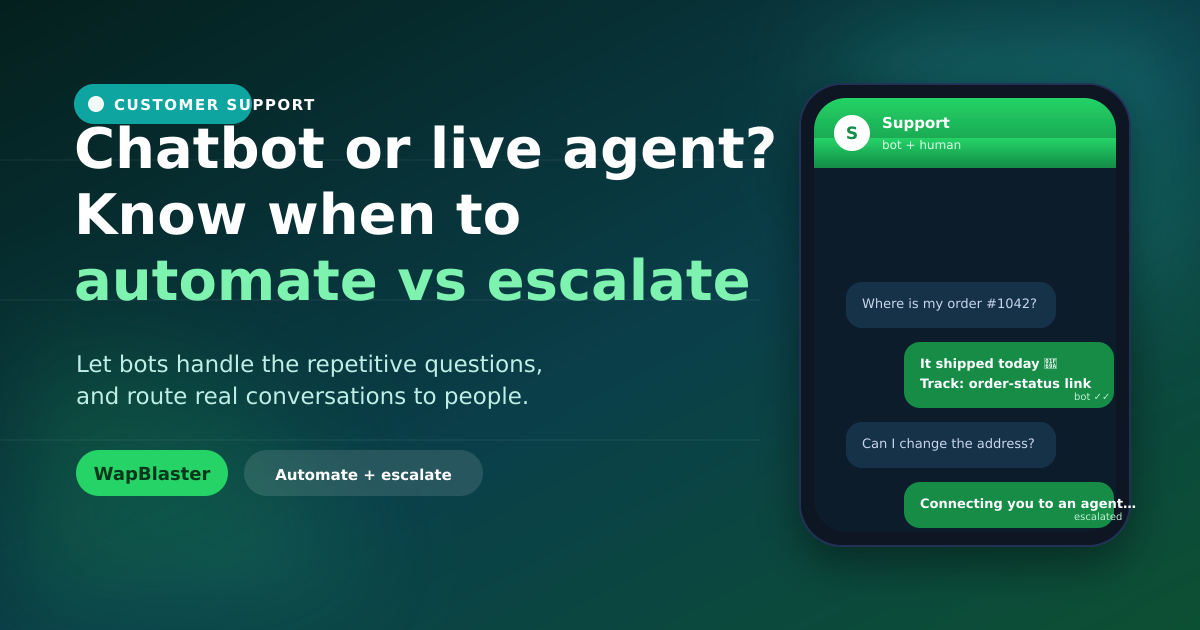
The best WhatsApp support does not choose between bots and humans — it uses each for what it does well. A chatbot answers instantly and never sleeps; a human handles nuance, empathy and exceptions. The skill is knowing where the handover line sits. Draw it in the wrong place and you either frustrate customers with a robotic wall or overwhelm agents with repetitive questions.
What a chatbot should handle
Automate the high-volume, low-complexity work where a correct answer exists and speed matters most:
- Order status, tracking links and delivery timelines.
- Store hours, location, pricing and common product questions.
- Routing: "Are you here about sales or support?"
- Collecting details before an agent joins (order number, issue type).
A well-designed WhatsApp chatbot resolves these in seconds and keeps queues short. For build principles, see our chatbot for business guide.
What a live agent should handle
Escalate when judgement, empathy or authority is required:
- Complaints, refunds and anything emotionally charged.
- High-value or complex sales conversations.
- Edge cases the bot was not designed for.
- Any situation where the customer explicitly asks for a person.
Design the handover, not just the bot
A smooth escalation carries context with it. When the bot hands off, the agent should see what the customer already typed so nothing is repeated. A shared team inbox makes this possible — the conversation, history and any collected details land with the right agent. Read our 24/7 helpdesk guide for the full setup.
Signals that should trigger escalation
- The customer repeats a question the bot did not resolve.
- Negative sentiment or frustration keywords.
- A request the bot has no confident answer for.
- An explicit "talk to a human" request — always honour it immediately.
Avoid the two common failures
The first failure is a bot with no exit — customers loop endlessly with no way to reach a person. Always offer a clear path to an agent. The second is escalating everything, which wastes your team on questions a bot should own. Review transcripts monthly and move newly-common questions into automation.
Measure the balance
Track containment (share resolved by the bot), escalation rate, first response time and customer satisfaction after both bot and human chats. If containment is high but satisfaction drops, your bot is holding conversations it should release. If agents are drowning in repetitive questions, your bot is releasing too early.
Frequently asked questions
Should a WhatsApp chatbot handle complaints?
No. A bot can acknowledge and collect details, but complaints need a human for empathy and resolution. Escalate quickly and pass the full context to the agent.
How do I stop customers getting stuck with the bot?
Always provide a clear "talk to a human" option, detect frustration and repeated questions, and hand off to a live agent through a shared inbox with the conversation history attached.
What percentage of chats should a bot resolve?
There is no universal number. Aim to automate repetitive, factual questions while keeping satisfaction high. If containment rises but satisfaction falls, rebalance toward human help.
Can WapBlaster route chats between bots and agents?
Yes. WapBlaster combines automated bot flows with a shared team inbox, so bots handle routine questions and hand off to the right agent with full context when needed.
Blend automation and human support the right way. See the shared team inbox or get started with WapBlaster.