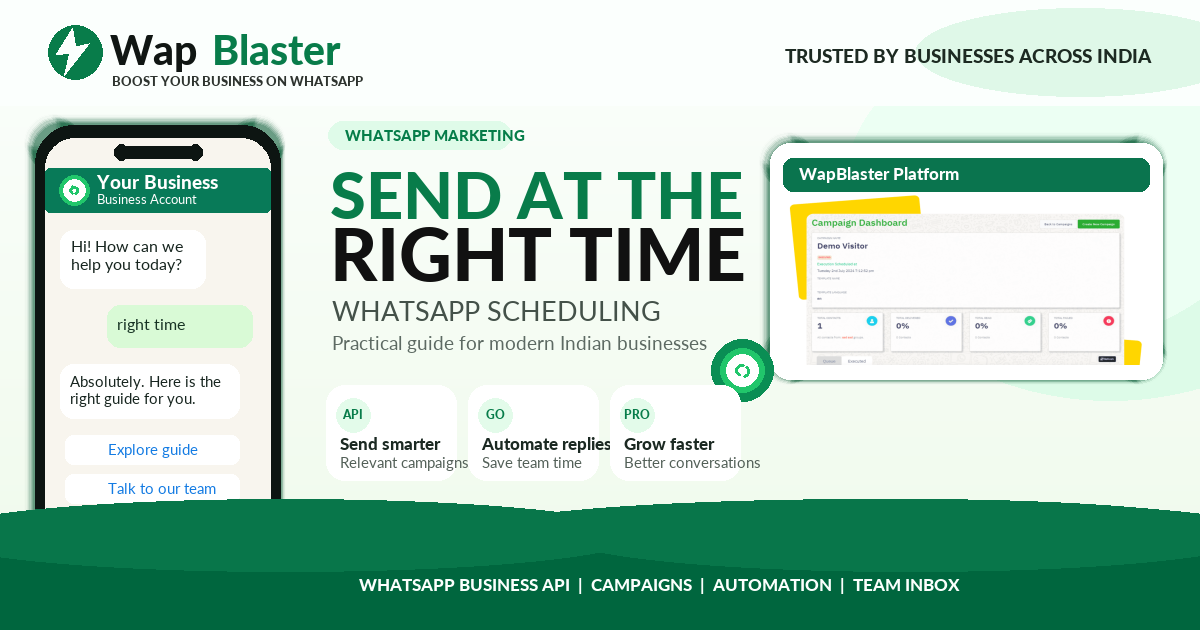
The same message can win or flop depending purely on when it lands. WhatsApp message scheduling lets you send at the moments your audience is most receptive, automatically and at scale. This 2026 guide covers why timing matters, when to send, and how to schedule campaigns that get read and acted on.
Why send time matters so much on WhatsApp
WhatsApp messages are usually read within minutes, so timing has an outsized effect. Send when your audience is busy or asleep and your message gets buried; send at the right moment and it is seen and acted on immediately. Scheduling turns good timing from luck into a system.
Finding the best time to send
There is no universal perfect time, but strong starting points include mid-morning and early evening, when people check phones between tasks. The real answer comes from your own data:
- Look at when past messages got the highest read and reply rates.
- Consider your audience's routine, work hours, commutes, downtime.
- Avoid very early mornings and late nights, which feel intrusive.
- Test a few windows and let results guide you.
Handling multiple time zones
If your audience spans regions, sending at one fixed time means someone gets it at a bad hour. Segment contacts by time zone and schedule each segment for its own local sweet spot, so everyone receives the message at a sensible local time.
Scheduling for different campaign types
- Promotions: schedule for peak receptive windows and before the offer deadline.
- Reminders: time them relative to the event, such as a day and an hour before.
- Drip sequences: space messages over days for steady nurturing.
- Transactional updates: send immediately; timing is dictated by the event.
Recurring and automated schedules
Beyond one-off sends, set recurring schedules for newsletters or weekly offers, and event-triggered schedules that fire relative to a customer action, like a reminder a day after signup. Automating the timing means perfectly-timed messages without manual effort.
Avoiding message fatigue
Good timing does not excuse over-messaging. Cap how often a contact hears from you, space campaigns sensibly, and watch opt-out and read rates. If reads fall or opt-outs rise, you are sending too often regardless of the hour.
Best practices for scheduled campaigns
- Schedule based on your own engagement data, not guesses.
- Segment by time zone for international audiences.
- Respect quiet hours to avoid feeling intrusive.
- Keep frequency in check to protect your quality rating.
- Review results and refine your send windows over time.
How WapBlaster helps
WapBlaster lets you schedule one-off, recurring and triggered campaigns with segmentation, so every message goes out at the right time automatically. Schedule smarter on the WapBlaster platform.
Frequently asked questions
What is the best time to send WhatsApp messages?
Mid-morning and early evening are strong general windows, but the best time is whenever your own data shows the highest read and reply rates.
Can I schedule WhatsApp campaigns in advance?
Yes. You can schedule one-off sends, recurring campaigns and event-triggered messages so they go out automatically at the chosen time.
How do I handle different time zones?
Segment your contacts by time zone and schedule each segment for its own local optimal time so no one receives a message at a bad hour.
Does scheduling reduce blocks and opt-outs?
Good timing helps engagement, but keeping frequency reasonable is what protects against fatigue, blocks and opt-outs.