Growth turns a helpful WhatsApp number into a bottleneck. What one person handled easily becomes a backlog, and customers wait. Knowing when and how to scale from a single number to a multi-agent setup is a key operational decision. This 2026 guide compares the two and shows how to grow without chaos.
The single-number stage
Early on, a single number managed by one person is perfectly fine. Volume is low, the owner knows every customer, and responses are personal and fast. This stage works, until it does not. The warning signs are slow replies, messages missed during busy periods, and the owner tethered to the phone. Recognising when you have outgrown it is the first step to scaling well.
Signs you have outgrown a single number
- Response times are slipping as volume rises.
- Messages get missed or answered late, especially outside hours.
- One person is a single point of failure when they are off.
- You cannot see who handled what, or measure anything.
- You need people in different roles, languages or regions answering.
How multi-agent works
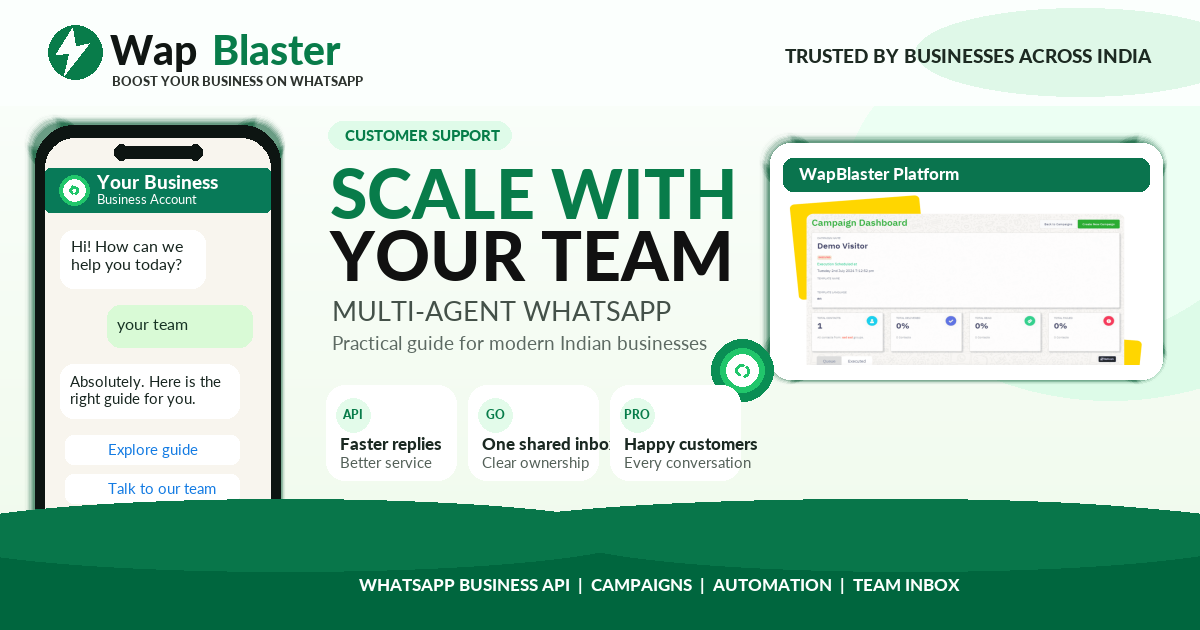
A multi-agent setup keeps one customer-facing number but lets many agents work it through a shared team inbox on the API. Conversations are assigned and routed so each has a single owner, agents log in with their own accounts, and supervisors see everything. Customers still message the same familiar number; behind the scenes, a whole team, plus optional automation, handles the load cleanly.
Single number vs multi-agent: the comparison
- Capacity: single number caps at one person's time; multi-agent scales with your team.
- Coverage: multi-agent supports shifts, roles and languages; a single number cannot.
- Visibility: multi-agent gives assignment, history and analytics; a single phone gives none.
- Resilience: multi-agent removes the single point of failure.
- Customer experience: faster, more consistent replies at scale.
Making the transition smoothly
Move deliberately. Migrate your number to the API, set up the shared inbox, define routing and assignment rules, and bring agents on with clear ownership. Introduce a chatbot to handle first-line questions so agents focus on what needs them. Keep your tone and quick replies consistent so customers feel continuity, not a jarring change. Done in this order, the transition is invisible to customers except that replies get faster.
Scaling further with automation
Multi-agent and automation reinforce each other. As volume grows, let the bot resolve common questions and qualify or route the rest, so you add agents for genuine complexity rather than repetitive queries. This keeps your cost per conversation in check even as total volume climbs, and it means scaling communication does not simply mean hiring linearly, you scale smarter, not just bigger.
How WapBlaster helps
WapBlaster runs your single business number as a multi-agent team inbox with routing, chatbots and analytics, so you scale customer communication without losing control. Grow cleanly on the WapBlaster platform.
Frequently asked questions
When should I move from a single WhatsApp number to multi-agent?
When response times slip, messages get missed, one person becomes a bottleneck, or you need multiple roles, languages or shifts answering customers.
Do customers notice when I switch to multi-agent?
Only that replies get faster and more consistent. They still message the same number; the team works behind the scenes through a shared inbox.
Does multi-agent mean a new number?
No. You keep your existing customer-facing number and run it on the API so multiple agents can handle it through one shared inbox.
How does automation fit with multi-agent?
A chatbot handles common questions and routes the rest, so you add agents for complex work rather than repetitive queries, keeping costs in check as you scale.