
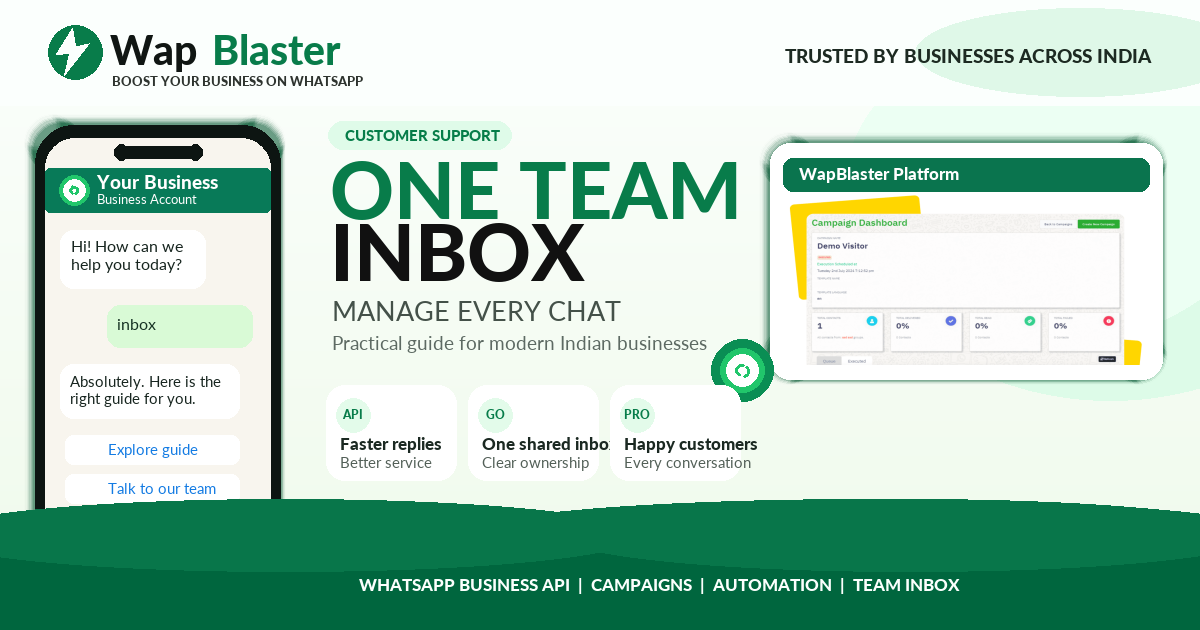
One WhatsApp number, many agents, and no chaos, that is what a team inbox delivers. As soon as more than one person needs to answer customers, the single-phone approach breaks down. This 2026 guide explains how a WhatsApp team inbox works and how to run customer conversations across a whole team without collisions or dropped messages.
The problem with a shared phone
When a team shares one physical phone or the Business App, everything competes: two agents reply to the same customer, messages get missed during handovers, there is no record of who said what, and nothing scales past a couple of people. Customers feel the disorganisation through slow or duplicated replies. A team inbox solves this at the root by putting the number on the API and giving every agent their own controlled access.
How a team inbox works
A team inbox connects your WhatsApp Business API number to a shared dashboard where multiple agents log in with their own accounts. Conversations can be assigned to specific agents, routed by topic or language, and tracked so everyone sees status at a glance. Only one agent owns a conversation at a time, which prevents the collisions that plague a shared phone, while supervisors retain full visibility.
Routing and assignment strategies
- Round-robin: distribute new chats evenly across available agents.
- By topic or department: sales enquiries to sales, support to support.
- By language or region: match customers to agents who fit.
- By priority: route high-value or urgent chats to senior agents.
Clear assignment rules mean every conversation has an owner and a sensible path, so nothing sits unanswered and no customer gets two replies.
Keeping conversations consistent
With several agents, consistency matters. Shared quick replies and templates keep tone and answers uniform, internal notes on a conversation let agents hand off with context, and a visible history means whoever picks up a chat knows what came before. This continuity makes a team of many feel like one coherent voice to the customer, even across shifts and handovers.
Measuring team performance
A team inbox turns support into something you can manage with data. Track response and resolution times, volume per agent, and customer satisfaction, and spot bottlenecks or training needs. Supervisors can see live workloads and rebalance, and reporting reveals which topics generate the most chats so you can fix root causes upstream. This visibility is impossible with a shared phone.
Scaling as you grow
The team inbox model scales smoothly. Add agents as volume grows, introduce a chatbot to handle first-line questions and route the rest, and layer in departments as your organisation matures. Because everything runs on one API number with structured access, growth does not mean chaos, it just means more agents working the same clean system.
How WapBlaster helps
WapBlaster provides a shared team inbox with assignment, routing, internal notes and analytics so your whole team handles customers from one number cleanly. Organise your team on the WapBlaster platform.
Frequently asked questions
Can multiple agents use one WhatsApp number?
Yes, through a team inbox on the WhatsApp Business API. Each agent logs in separately, conversations are assigned to one owner at a time, and supervisors keep full visibility.
How does a team inbox prevent two agents replying at once?
Each conversation is assigned to a single agent as its owner, so others do not reply over them, unlike a shared phone where anyone can jump in.
Can I route chats to specific agents or departments?
Yes. You can route by topic, department, language, region or priority so each conversation reaches the right person automatically.
Does a team inbox work with a chatbot?
Yes. A chatbot can handle first-line questions and collect details, then hand off to the right agent in the shared inbox with full context.