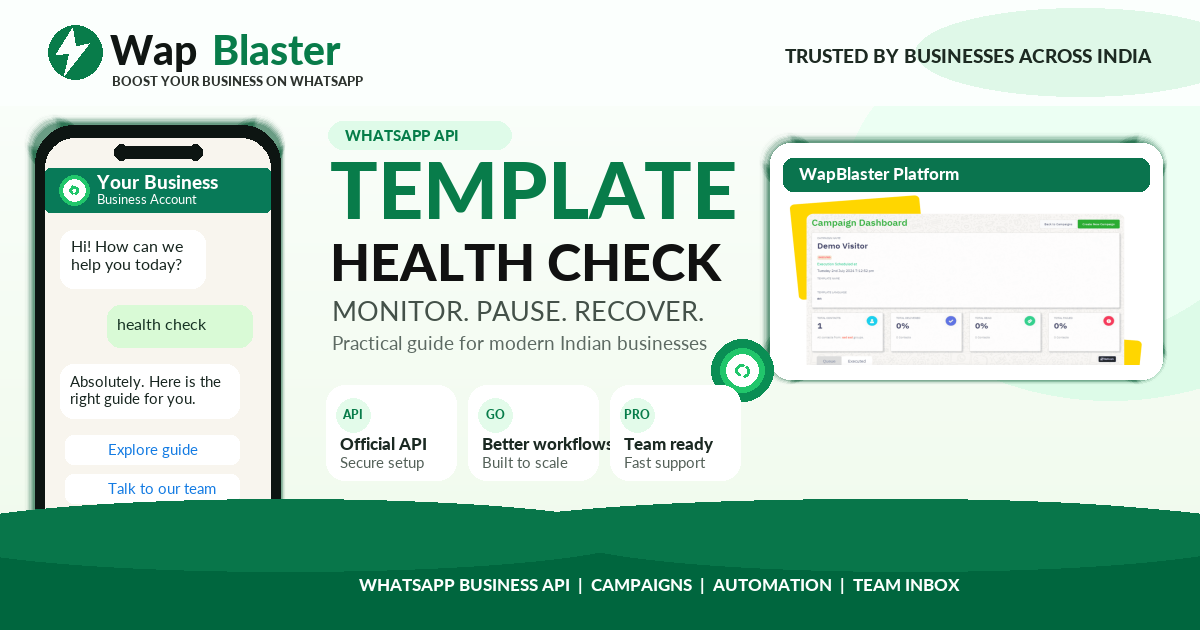
A WhatsApp template can be technically approved and still become a performance problem later. Quality signals reflect how recipients react after delivery: engagement, blocking, reporting and relevance all matter. The practical goal is not simply to keep a template available; it is to send messages people expect and value.
This playbook helps teams turn quality changes into an operational workflow. It covers what to monitor, how to pause risky sends, how to repair the underlying journey and how to restart with a smaller, better-targeted audience.
Understand the signal before changing the copy
Treat a quality drop as evidence to investigate, not as a reason to resend the same message more aggressively. Review the audience source, the promise made at opt-in, the message category, send frequency and the destination experience together. A polished template cannot compensate for a list that did not expect the message.
Separate template approval from recipient satisfaction. Approval checks whether a template can be used; ongoing quality indicates whether your live audience finds that use welcome and relevant.
- Compare recent sends by source, segment, language, offer and send time.
- Review opt-out, block, report, delivery and reply patterns together.
- Keep a dated record of template versions and the journey that triggered each one.
Build a daily template health check
Make the review actionable: pair template health with the WhatsApp analytics metrics that matter so owners can spot audience fatigue before a wider send.
Create a compact dashboard or review sheet that shows sends, delivery, replies, opt-outs and any quality warnings by template. Use it during the campaign, not only at month end. A small negative pattern is much easier to correct before it affects a larger audience.
Assign ownership. Marketing can own relevance and audience selection, while operations can own approval status, volume controls and stop rules. This prevents a warning from being lost between teams.
- Set a clear threshold for pausing a campaign.
- Check whether an offer has already been sent recently to the same segment.
- Compare performance against a useful baseline instead of relying on one campaign alone.
What to do when a template is paused or performs poorly
Before changing the wording, revisit the WhatsApp template approval guide to confirm that the category, language and variables still fit the customer journey.
Stop sending the affected journey first. Do not create several near-identical templates just to continue the same campaign. Look for the real cause: unclear consent, an overly broad audience, weak value, misleading urgency or a message that does not match the original sign-up expectation.
Then rewrite the full experience. Make the first line specific, state why the recipient is hearing from you, offer one useful next step and include a clear way to stop future updates. Restart only after the audience and the message are both improved.
- Audit the opt-in wording and landing page.
- Reduce the first recovery audience to recent, engaged contacts.
- Use a utility update where the recipient is expecting an order or account message; do not disguise promotions as utilities.
Recover with relevance instead of volume
A recovery launch should be smaller and more intentional than the original campaign. Start with people who recently interacted, purchased, requested an update or explicitly subscribed to that subject. Personalise the context where your data supports it, but never add personal details that feel unexpected.
Measure whether the revised message earns replies and clicks without increasing opt-outs. If the audience does not respond, improve the offer or cadence before increasing volume.
- Segment by customer lifecycle, not only by city or age.
- Rotate useful updates, reminders and offers so every message is not a sale.
- Give teams one documented approval path for new variants.
Connect quality monitoring to your campaign workflow
Build this check into the same process as your WhatsApp marketing compliance controls; consent, relevance and cadence are connected operational decisions.
The best prevention is a campaign process that checks consent, category, targeting and expected value before the send is scheduled. Build those checks into your template and campaign approval checklist. It is much easier to prevent fatigue than to repair it after a quality event.
For a broader foundation, use the template approval guide alongside your compliance process. It helps teams decide whether a campaign is appropriate before it reaches a customer.
Helpful next reads
WhatsApp message template approval guide, WhatsApp marketing compliance guide, bulk messaging safety checklist.
Frequently asked questions
What does a WhatsApp template quality warning mean?
It is a signal to review how recipients are reacting to the message and the journey behind it. Pause risky sends, investigate audience relevance and improve the experience before scaling again.
Should we duplicate a paused template and send it again?
No. Creating a near-identical replacement without fixing consent, targeting or value can repeat the same problem. Repair the audience and campaign logic first.
How can a team prevent template fatigue?
Set frequency rules, segment by intent, alternate useful updates with offers and monitor opt-outs and engagement during each campaign.