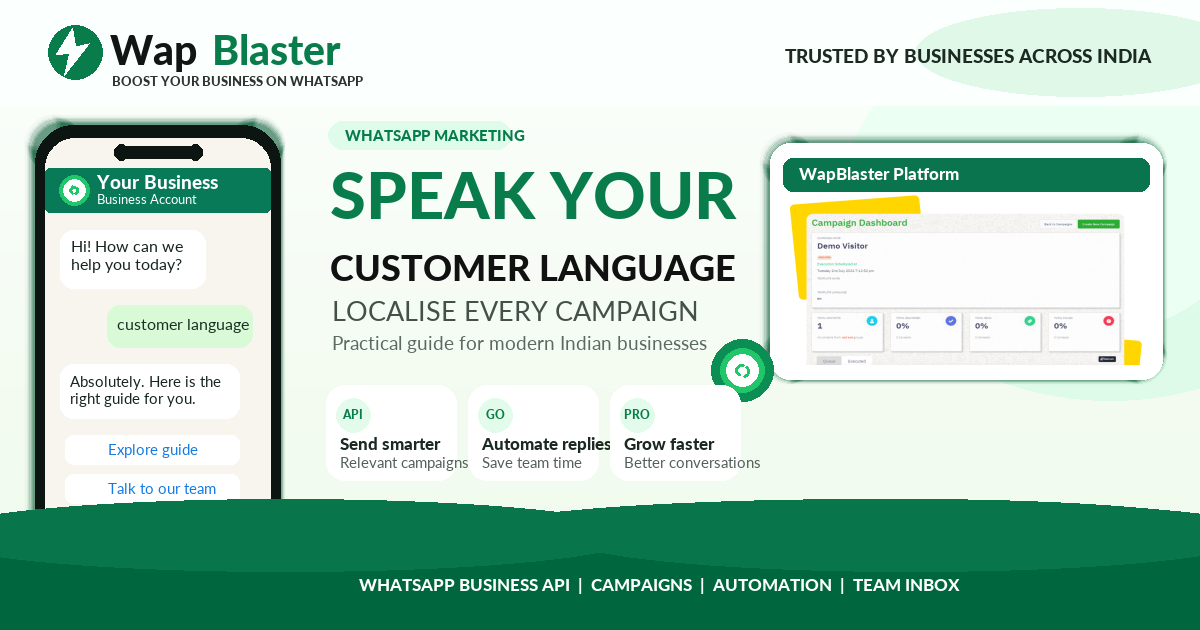
Language can make a WhatsApp campaign feel personal and useful, but a literal translation can do the opposite. Effective multilingual messaging matches the customer preference, local context, call to action and service capacity behind the campaign.
This guide gives marketing and operations teams a practical localisation workflow that protects clarity across templates, landing pages, support routing and measurement.
Choose language from permissioned customer data
Language preference should sit alongside a valid opt-in; use the WhatsApp opt-in guide to improve both fields at the point of consent.
Use a declared customer preference where possible. Do not infer language from a name, location or browsing event alone. A simple preference field collected at sign-up or checkout gives the campaign team a much safer starting point.
Where preference is unknown, start with the language used in the customer journey that produced the opt-in and make it easy for the customer to change their choice.
- Capture preferred language at opt-in.
- Keep preference data available to campaign and support teams.
- Do not over-personalise based on weak assumptions.
Localise the whole experience
For variable-driven messages, the personalisation guide explains how to keep dynamic content relevant without making it feel intrusive.
A translated template is only one part of the journey. Check the link destination, product names, currency, support hours, reply options and agent routing. A customer should not receive a message in one language and reach a form or agent flow in another without warning.
Keep important actions short and unambiguous. If a phrase has a local interpretation that changes the offer or instruction, rewrite it rather than translating word by word.
- Review every button and URL destination.
- Match language to support capability.
- Use regionally appropriate dates, units and currency references.
Set up a real quality-assurance pass
Ask a fluent reviewer to check meaning, tone, layout and variable placement on an actual device. A spelling check cannot detect an awkward call to action, a culturally inappropriate phrase or a placeholder that breaks the sentence order.
Test each language variation with the correct variable lengths. Names, cities and product labels can make a well-designed message wrap badly when inserted into another language.
- Preview text with real variable examples.
- Test buttons and links in each language.
- Record approved copy and reviewer ownership.
Measure by language segment
Review language performance in the same dashboard as the core WhatsApp analytics metrics to distinguish delivery from meaningful engagement.
Do not judge a multilingual programme only by total delivery. Compare replies, opt-outs, conversions and support outcomes by language and entry source. This reveals whether the translation is clear and whether the right people are receiving it.
Use the findings to improve your preference capture and campaign planning. A smaller, well-matched local-language send often performs better than a broad campaign translated at the last minute.
Helpful next reads
WhatsApp message personalisation guide, WhatsApp copywriting guide, WhatsApp campaign analytics guide.
Frequently asked questions
Should I translate one WhatsApp template word for word?
No. Localise meaning, tone, call to action and the linked experience so the message feels natural and remains accurate in the customer’s language.
How should we choose a customer language?
Use a declared preference where possible, then maintain it as part of the permissioned customer profile.
What should multilingual campaign QA include?
Check message meaning, variables, layout, buttons, links, support routing and the destination experience in every language version.