

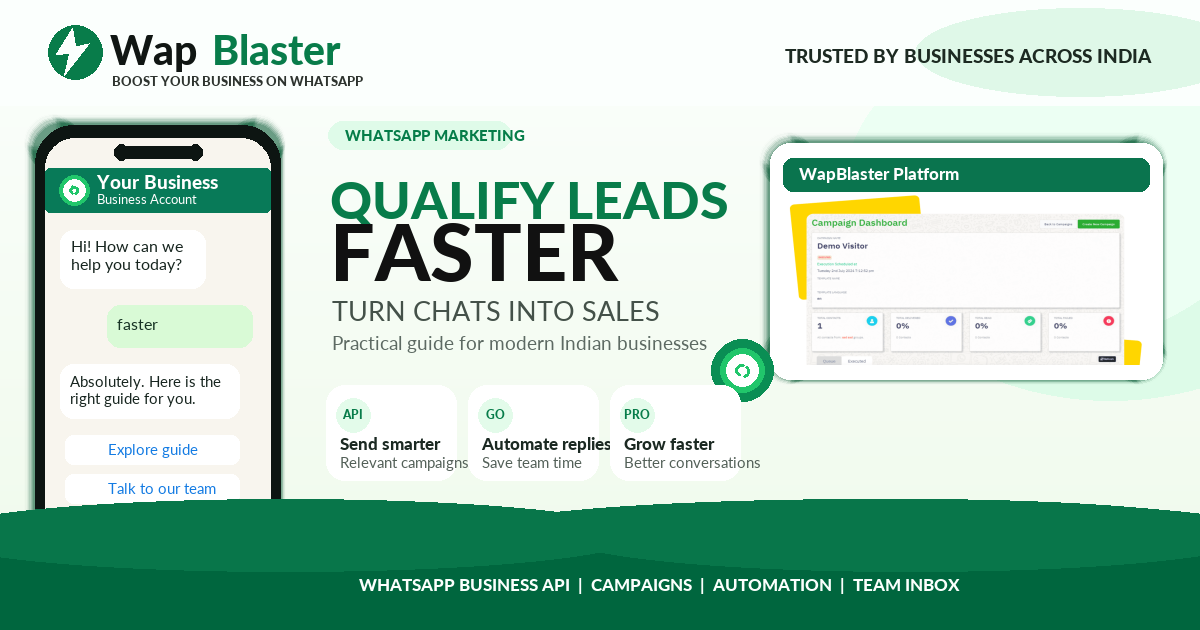
A new WhatsApp lead is most valuable while the customer’s intent is fresh. The objective of qualification is not to interrogate people with a long form; it is to learn enough to give them the right next step quickly.
A good qualification flow combines a short conversation, useful choices, routing rules and a human handoff when the opportunity needs more context. It helps sales teams respond faster while giving customers a clearer experience.
Define what your team needs to know
Use the WhatsApp lead-generation guide to decide which qualification details genuinely change the next sales action.
Start with the smallest information set that changes the next action. Depending on the business, that may be product interest, location, budget range, timeline or whether the person is an existing customer. Avoid collecting details simply because a field exists in the CRM.
Write every question from the customer’s perspective. Explain how the answer improves their next step, such as matching them with the right plan, location or specialist.
- Limit the first flow to decision-making fields.
- Use clear choices where they are faster than free text.
- Allow customers to ask a question or speak to a person.
Use routing rules that customers can feel
Route qualified opportunities into a clear team inbox ownership model so customers do not receive duplicate agent replies.
A lead should move to the team or workflow most able to help, not merely the first available queue. Route by product, location, urgency, language or customer type only when the rule has a real service purpose.
Keep handoffs visible. If a customer is transferred, tell them what will happen next and when. Silent handoffs create duplicate follow-ups and lower trust.
- Map ownership for every lead type.
- Set an acknowledgement and follow-up target.
- Avoid sending the same lead to multiple agents without coordination.
Follow up with context
For ad-led conversations, pair follow-up logic with the Click-to-WhatsApp ads guide to keep the message aligned with the original promise.
When a lead does not respond, a useful follow-up should refer to the declared interest and give one easy action. Do not send repeated generic reminders. If the person asked about a product, share a relevant answer, booking option or comparison rather than a broad sales message.
Use frequency limits and stop rules. Lead qualification should improve relevance, not create a reason to message people more often than they expect.
- Make each follow-up contextual.
- Use an approved template where required for business-initiated outreach.
- Measure reply quality, not only total sends.
Review conversion handoffs weekly
Look at where qualified leads stall: first reply, agent assignment, proposal, booking or payment. The highest-volume issue is not always the biggest opportunity. A small handoff delay in a high-intent segment can be more valuable to fix than a broad top-of-funnel metric.
Feed real objections back into the qualification flow. Over time, the best questions and quick replies become clearer because they are based on customer language.
Helpful next reads
WhatsApp Business API lead generation guide, Click-to-WhatsApp ads guide, WhatsApp chatbot best practices.
Frequently asked questions
What is the first question to ask a WhatsApp lead?
Ask the question that most changes the helpful next step, such as the product need, timeline or preferred location. Keep it short and explain why it helps.
Should lead qualification be fully automated?
Use automation for clear, repeatable choices and routing, but make it easy for customers to reach a person when they have a nuanced question or high-value need.
How should we follow up with an unresponsive lead?
Send a relevant, permissioned follow-up tied to the expressed interest, offer one easy action and respect frequency and opt-out rules.